Car oil will run in your motorcycle. It is cheaper, it is probably already on your shelf, and the bike will start and ride and give you no reason to think anything is wrong.
That is what makes it dangerous.
I know, because I put car oil in one of ours.
Not out of carelessness. There was a jug already on the shelf, and going out to buy a different one felt wasteful when perfectly good oil was sitting right there. I was trying to save money.
The clutch slipped. Not a little, and not briefly. It slipped enough to wear down the first plate in the pack, and by the time we were finished we had replaced all of the plates and all of the friction plates.
I saved the price of one jug of oil.
That is the whole article, really. But here is why it happens, so it does not happen to you.
Your motorcycle has a wet clutch
On most bikes, one oil is doing three jobs at once. It lubricates the engine, it protects the gearbox, and it sits around the clutch plates.
That last one is the problem, and it is the whole reason motorcycle oil exists as a category.
A car has a dry clutch or an automatic, and its oil is in a sealed system doing one job. So car oil is engineered to reduce friction, because friction is loss, and less of it means better economy and less wear.
Your clutch needs friction. That is how it grips. That is how power gets from the engine to the back wheel instead of turning into heat.
Put car oil in a bike with a wet clutch and you have poured something engineered to reduce grip into the one place you need grip. The clutch slips. The plates cook. Things run hotter than they should.
Read the bottle: JASO
The rating you are looking for is JASO, from the Japanese Automotive Standards Organization. They introduced the T903 standard in 1998 and it is now the global benchmark for four-stroke motorcycle oil.
Oils are graded by an actual clutch friction test, measuring three things: how the clutch feels as it engages, how much torque it holds before slipping, and how quickly it locks up.
Four grades came out of that.
| Rating | What it is | For your bike |
|---|---|---|
| JASO MA | Wet clutch standard. No friction modifiers. | Yes |
| JASO MA2 | Higher friction subcategory, added 2006 | Yes |
| JASO MA1 | Lower friction subcategory | Check your manual |
| JASO MB | Scooters and automatics. Contains friction modifiers. | No |
JASO MB is the trap
This is the one worth remembering.
MB is motorcycle oil. It is on the same shelf, in the same aisle, from the same brands. It is made for scooters and automatic transmissions, where there is no wet clutch to worry about, and it has friction modifiers in it for fuel economy.
In a bike with a wet clutch, MB will slip it.
Nothing on the front of the bottle warns you. You have to look for the JASO rating and know what the letters mean. Now you do.
So what do I actually buy
Look for JASO MA or MA2 on the bottle, then check your owner’s manual for the viscosity your bike wants.
That is it. Two things: the JASO rating and the grade in your manual.
If a bottle does not carry a JASO rating at all, it is not motorcycle oil regardless of what the label suggests.
What actually happens if you get it wrong
Not an explosion. Something slower, and worse than it sounds.
The clutch starts slipping under load. Usually first when you are accelerating hard or climbing. The revs rise and the speed does not follow. It is easy to tell yourself it is something else, or that it will settle.
It does not settle. Every time it slips, the plates are grinding against each other instead of gripping. That wears them down, and it wears them unevenly, so the first plate in the pack takes the worst of it.
That is where mine ended up. The first plate was worn down far enough that replacing just that one was not the answer. We did the whole pack: every plate and every friction plate.
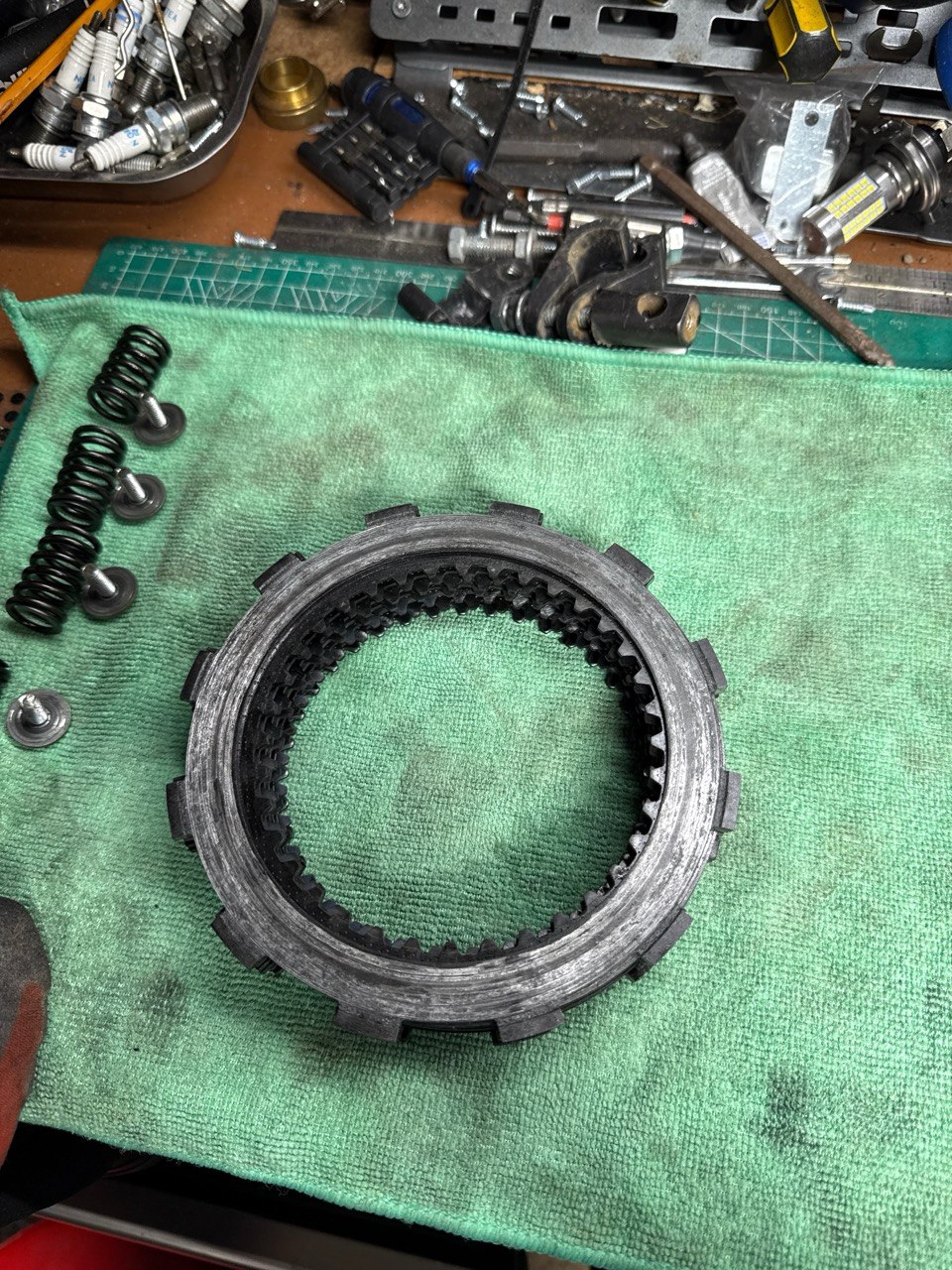
So the actual cost of using the wrong oil was not a wasted jug of oil. It was a clutch pack, and the afternoon it takes to get in there.
If you have just put car oil in and you catch it now: drain it and refill with the right stuff. That is cheap, and that is the whole fix. Riding on it is what costs money.
I did not catch it in time. You can.
Why I put this on its own page
Because it is the mistake that costs the most and gets explained the least.
Every oil change guide tells you which socket and how many quarts. Almost none of them tell you that the bottle is the part you can get wrong before you have even picked up a tool.
I have done a lot of things wrong in a garage. This is the one that cost the most for the smallest reason.